
Interesting Facts About Armstrong County
Discover the stories, trivia, records, legends, and little-known details that make Armstrong County unique. Whether you are researching local history, working on a School project, tracing family roots, or simply curious, this collection of fascinating facts offers something new to learn and share.
When NASA launched the famous Apollo moon missions in the 1960s, residents of Apollo, Pennsylvania embraced the connection. The town celebrated the Apollo 11 moon landing and proudly promoted its unique link to one of the most famous names in American history.

Who is Wayne Township named for?
Wayne Township was named in honor of General Anthony Wayne (1745–1796), one of Pennsylvania’s most famous military leaders.
Born in Chester County, Pennsylvania, Wayne earned the nickname “Mad Anthony” for his bold leadership during the American Revolution. His military successes made him a national hero, and communities throughout Pennsylvania later adopted his name for townships, counties, and other landmarks.
Wayne Township in Armstrong County is one of several Pennsylvania communities named in his honor.
Photo: oil on canvas portrait by Edward Savage, c. 1795.

Why is Apollo Called Apollo?
Before it became the Borough of Apollo, the community was known as Warren’s Sleeping Place, a name believed to honor trader Edward Warren, who often camped along the banks of the Kiskiminetas River. When the town was officially laid out in 1816, it was named Warren.
However, when a post office was established, officials discovered that another Pennsylvania community already used the name Warren.
To avoid confusion, a new name was needed. The community chose Apollo, inspired by the ancient Greek and Roman god associated with music, healing, light, prophecy, and enlightenment.
Today, Apollo remains one of Armstrong County’s most distinctive place names and is a reminder that local history can sometimes be found in the most unexpected places—even in ancient mythology.

Why Is It Called Brady’s Bend?
Brady’s Bend Township takes its name from two important features of local history.
The first is Captain Samuel Brady, a legendary frontier scout and Revolutionary War hero known for his daring exploits throughout western Pennsylvania.
The second is the dramatic horseshoe-shaped bend of the Allegheny River that forms much of the township’s eastern boundary.
The township’s name combines both the man and the landscape, creating one of the most distinctive place names in Armstrong County.

Armstrong County native S. K. McClafferty became a published author, editor, and historian in the late 1800s. His writings helped preserve the stories of Pennsylvania’s pioneers and early settlements for future generations.
Armstrong County By the Numbers
1796
The year Armstrong County, PA was established.
45
Armstrong County, Pennsylvania is divided into 45 distinct municipalities. This total is made up of 1 city (Parker City), 16 boroughs, and 28 townships.
63
Exactly 63 miles of the Allegheny River flows through Armstrong County, cutting directly from the northern to the southern border of the county.
4
A bridge has been built four times over the Allegheny River at the downtown Market Street crossing in Kittanning.
Did You Know?
The Allegheny River flows north.
Unlike most rivers in Pennsylvania, the Allegheny River flows north through Armstrong County before eventually joining the Monongahela River in Pittsburgh to form the Ohio River.

Mothman Prophecies
In 2001, downtown Kittanning and several locations throughout Armstrong County became a Hollywood film set when scenes for the supernatural thriller The Mothman Prophecies were filmed here. Released in 2002 and starring Richard Gere, the movie is based on reports of mysterious sightings and unexplained events associated with the legendary “Mothman” of Point Pleasant, West Virginia.
Rather than filming in Point Pleasant, director Mark Pellington selected Kittanning to portray the fictional town featured in the movie. The community’s historic architecture, small-town atmosphere, and practical filming logistics made it an ideal location for the production.
Several recognizable Kittanning landmarks appear throughout the film. The Kittanning Citizens Bridge served as the backdrop for some of the movie’s most dramatic scenes, while Market Street was transformed into a bustling West Virginia town complete with altered storefronts and movie-set decorations. The Armstrong County Courthouse also appeared on screen after being dressed with seasonal decorations to fit the film’s storyline.
For several weeks, local residents watched as film crews, equipment, and actors brought Hollywood excitement to the streets of Kittanning. Many community members worked as extras or assisted with the production, making the project a memorable chapter in the borough’s history.
Photo: Mothman Lives website

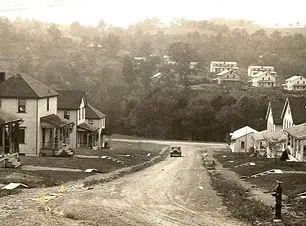
Johnetta Brickyard in Gilpin
Johnetta was once home to one of Armstrong County’s most important brick and clay manufacturing operations. Located in Gilpin Township along the Allegheny River, the community grew around the Johnetta Brickyard and the nearby clay mines.
The operation utilized the famous Kittanning clay seam, known for its exceptional purity and quality. This clay was transformed into face brick, pavers, sewer pipe, and refractory products that were shipped throughout the region.
At its peak, Johnetta was a thriving company town with homes, a school, church, store, and recreational facilities serving hundreds of workers and their families.
Today, the brickyard remains an important reminder of Armstrong County’s rich industrial heritage and the role local natural resources played in building communities across America.
FUN FACT:
The clay seam beneath Johnetta was approximately 15 feet thick and was considered one of the finest clay deposits in western Pennsylvania.
.webp)
What Community was once named Mt. Lorenzo?
Before it became the Borough of Worthington, the community was known as Mount Lorenzo. Laid out in the 1830s at the crossroads of two important stagecoach routes, the settlement later adopted the name Worthington in honor of Thomas Worthington, an early United States Senator from Ohio.
Worthington developed into an important agricultural and industrial community in western Armstrong County. Over the years, the area became known for more than farming and coal mining.
Nearby is the famous Yellow Dog Village, a former company town built in the 1920s that earned its unusual name from labor contracts that discouraged union membership.
Another little-known piece of local history is the area’s connection to underground mushroom farming, one of the more unusual industries to operate in the region.
Today, Worthington continues to celebrate its heritage through the annual Worthington Carnival and Farmers & Antique Car Parade, traditions that bring the community together each summer.

Kittanning's " Millionaire Row"
During the late 1800s, Kittanning’s Water Street became known as “Millionaire Row.” Industrialists who built fortunes in coal, natural gas, iron, glass, brick, and banking constructed elegant Victorian mansions overlooking the Allegheny River. Local historians have long noted that, for a time, Water Street reportedly had more millionaire residents per block than anywhere else in Pennsylvania. Although many of these magnificent homes have disappeared, the story of Millionaire Row remains a reminder of Armstrong County’s remarkable industrial prosperity during the Gilded Age.
I'm a paragraph. Click here to add your own text and edit me. It's easy.
Armstrong County is home to 11 official Pennsylvania Historical Markers, commemorating Native American history, the French and Indian War, the American Revolution, industrial innovation, labor, religion, journalism, and the communities that have defined our region for centuries. Together, these markers create an outdoor museum that invites residents and visitors alike to explore our rich heritage.
Official Pennsylvania Historical Markers in Armstrong County
-
Armstrong County
-
Blanket Hill
-
Brady’s Bend Works
-
Fort Armstrong
-
General John Armstrong (Plaque)
-
Kittanning (Applewold)
-
Kittanning (South Water Street)
-
Kittanning or Attique Indian Town (Plaque)
-
Nellie Bly
-
Pittsburgh Plate Glass Ford City Works
-
St. Patrick’s Church

Did you know Armstrong County is the hometown of one of America’s original “Rosie the Riveters”?
Before women routinely entered America’s industrial workforce, one young woman from Armstrong County answered the call to serve her country.
Delphine Virginia Tedeski Klaput, born in Cadogan in 1924, left home at just 19 years old during World War II to work at the Glenn L. Martin Aircraft Company in Baltimore. There, she served as a classified documents clerk, handling blueprints and other sensitive materials that supported the nation’s wartime aircraft production.
In 2024, Delphine was among the surviving original “Rosie the Riveters” awarded the Congressional Gold Medal, one of our nation’s highest civilian honors, recognizing the extraordinary contributions of the millions of American women who helped secure victory during World War II.
Her remarkable story reminds us that Armstrong County’s history extends far beyond our borders. The courage, patriotism, and dedication of local residents like Delphine helped shape our nation’s history.
Thank you, Delphine, for representing Armstrong County with honor and for your extraordinary service to our country.
Sources:
• Rosie the Riveter Association of Michigan – Delphine Tedeski Klaput Profile
• WLOX News interview with Delphine Klaput (July 2026) and Photo Credit WLOX News
Ready to Discover More?
Every community has a story. Visit the Armstrong County Historical Society
and discover the people, places, and events that shaped our region.